Antarctica and Patriot Hills
I have always wanted to go to Antarctica, and in Afghanistan I met a man who went there regularly. John is a GP who works in a remote part of New Zealand and clearly has the bug for adventure.
All trips to wild places are organized on the old boy network, and so he kindly wrote to Antarctic Logistics and Expeditions (ALE) on my behalf to ask if they had a vacancy for a doctor. The answer was brief and negative. They did not. They had enough doctors for the next season, and all that they needed was a nurse. I suppose that one of the things that I have learnt over the years ‘Never to take ‘no’ for an answer’. If it is something that you really want then persevere. I really wanted to go to Antarctica and they wanted a nurse, so I offered to go as a nurse. They said that they would let me know, but they didn’t. Once again, that is not enough, so every couple of weeks I dropped a short and friendly note just checking that no vacancy had arisen, and then it did. They had no cover for the second half of the season. Could I go for six weeks at short notice?
My favourite book was and is Shackleton’s ‘South’ and now I was to have a chance to see the real thing. Except that I didn’t. ALE is a company which flies tourists into Antarctica, who want to climb, sledge or visit the pole. It also provides Logistical support to various small government programmes which cannot justify having their own planes down in Antarctica. At that time they had a tented camp at the foot of the Patriot Hills just off to one side of the Ellington Mountains. It is in the middle of nowhere. You can travel in any direction for at least 300 miles and there will be no trace of life, human, mammal or bird. You are in an ice desert. It was a tented camp, which was dismantled every February at the end of the season, and buried until the end of November, the start of the next season.
All the tents were then re-erected and the camp ran flat out day and night for 10 weeks before closing down again in the Antarctic autumn. ALE had their base head quarters in Punta Arenas in southern Chile, a town of ferocious winds and plastic bags plastered on everything, fences, bushes and telephone wires.

Punta Arenas. A land of ferocious winds, a million plastic bags and dustbins up on poles to stop the packs of feral dogs from looting them
The flight down to the southern tip of South America was a long one, and I was much more worried than usual that I might not have the right gear with me. After all we were going to be high on the Antarctic plateau less than 600 miles from the South Pole. John had warned me that I needed at least four pairs of gloves as they blow away in the howling wind, and if a client loses a glove you may have to give them one of yours. I also had huge difficulty getting hold of insulated boots. They only seemed to be made in Canada and were ferociously expensive even before postage. There were also very heavy so I had to travel in them.
When I arrived in Punta it was to find that a private house had been converted into offices for ALE and that each year a team of Chileans and ex-patriates gathered there to support the workers on the ice, ordering supplies, clearing customs, repacking and sending on to Patriot Hills. Almost everyone there had worked for the company for years and were climbers, and explorers in their own right, who had decided to make a profession of their passion. None of them talked much about their previous exploits but gradually, as you got to know them, fascinating stories would start to come out of ship-wreck on remote Antarctic Islands, aircraft crash landing on the ice, and falls down crevasses. And we had plenty of time to talk.
The weather was no good, so we could not fly into Patriot Hills for ten days. We hung around the office in the day, driving the base logistical staff crazy, as they had tons of work to do and we had none. Then in the evening we would remove ourselves to one of the pubs and continue our enforced leisure there. Just North of us was a wonderful National Park , Torres del Paine, with some of the most spectacular mountains in the world, but we were always on short notice for take-off so could not go up there in case the flight was called. So near and yet so far. Even so, I walked all over Punta Arenas and into the hills behind. It is a real frontier town, and the delay just made Antarctica even more interesting.
Getting into Patriot Hills at the beginning of the season was a fascinating exercise in logistics. The first aircraft in were two Twin Otters, a small twin engine aircraft loaded to the gills with fuel, and fitted with skis.

Twin otter coming in to land
They would have to wait until the satellite photos suggested that the weather was OK, and when there was no head-wind they would fly across the Drake passage, a very dangerous crossing indeed, and then up the Antarctic peninsula until they were deep in the Heritage Range. Once they had landed on the ice, the engineers on board would uncover the snow-ploughs and piste bullies and try to warm them up before starting them. Once they were started they could push the snow off the trench where the tents were buried and start erecting somewhere to live. Slowly but surely the camp would come out of hibernation and start to hum again.

The camp being erected. Mess tent and crew accommodation tents
Their next job was to try to clear the snow off the main blue ice runway. There is very little snow fall in Antarctica because most of it is a desert, but snow drifts all the time, pushed along by the fierce catabatic winds that pour down from the South Pole. The blue runway at Patriot Hills is a natural formation created by the vortex in the lee of the Patriot Hills. If the wind is strong enough it blows all the snow clear and exposes the smooth ice below. However if the wind is too strong then aircraft cannot land on the blue ice because it is aligned across the wind and planes would be blown off the runway.
The window between the wind being too light and it being too strong was very narrow indeed. What the start of season crew hoped was that initially the wind would be strong so that there would not be much snow to clear. Then they would hope for light winds so that the main aircraft could land. This year the delay was more than 10 days before the runway was clear, and then it got blocked again.

Snow blower clearing the runway
We all flew in using an enormous Russian transport plane, an IL76.
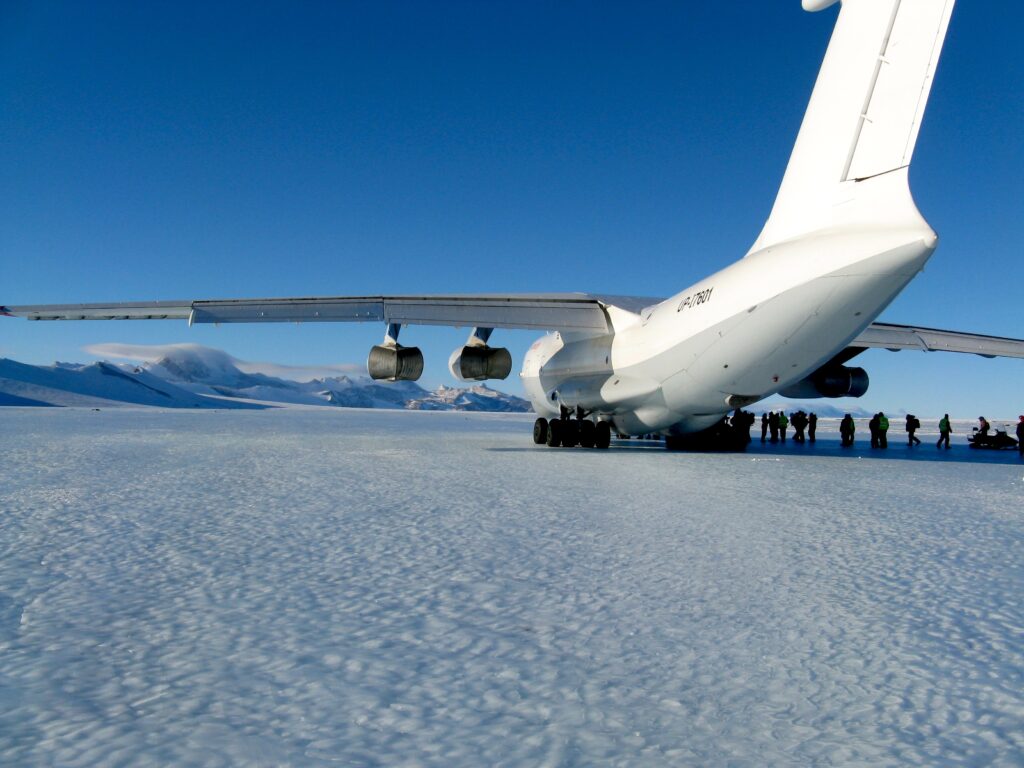
Russian IL76 on the ice. It takes miles for them to stop as they can’t use their brakes on the ice.
It is specially designed to land on rough surfaces. This aircraft has wheels not skis so can only land on hard ice not snow. It then cannot brake normally as there is no grip on the ice, so it needs an enormous length of runway to stop, as it only has its reverse thrust to slow it down. The decision when to fly is a huge gamble as the weather may change during the 4 ½ hour flight down there, and if it does then they have to turn back. The aircraft must also land heavy as it has to have enough fuel to fly all the way back.
The Russian crew who fly the plane are quite delightful. They fly all over the world, always into dangerous places and work very closely as a team. The aircraft itself is astoundingly old (1960s) with valve sets rather than transistors, but everything is so over-engineered that very little seems to break. Even so they fly in from Kazakstan with a spare engine and several spare wheels on board. The plane itself is enormous so it can take tons of fuel in drums, Snow-mobiles and then a hundred passengers on top of that. The crew are very relaxed about flight safety so you can wander up onto the flight deck (it is up an iron ladder) or into the nose cone where the bomber aimer would have lain.
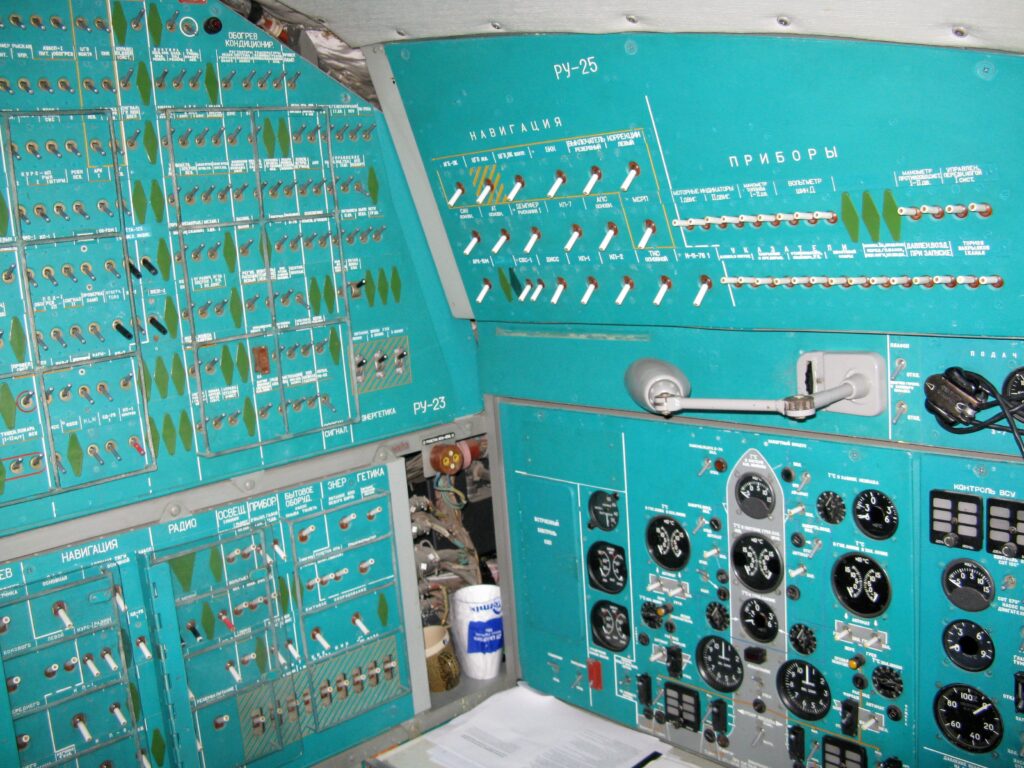
Inside an IL76. Valve sets and everything built ten times stronger than it needs to be.
My first sight of Antarctica took my breath away. It is so big, so still and utterly beautiful. It is eerie to look out over a range of mountains on which no man has ever set foot.
The landing seems to go on for ever, as the aircraft travels nearly three kilometers before it stops. During that time the aircraft is vulnerable to a gust or even to the slope of the ice, as the glacier is not completely flat, so everyone is holding their breath. Once we stopped, we taxied back up to the initial landing site while all of us pulled on gloves, puffer jackets, hats and goggles so that by the time that the doors opened we were all boiling in our polar gear. The light outside was blinding. It was bright sunshine on white snow and blue ice. I clambered down the steps onto the ice and before I had taken the first step I had slipped and landed flat on the back of my head. I was conscious enough to realize that if I had a serious head injury here, I could not be in a worse place. I staggered to my feet and tried to take in my surroundings. Piste-bullies with trailers on skids were already manoeuvring into the back of the aircraft to start unloading all the freight. The aircraft has to keep its engines running so that they don’t freeze up and the noise of huge howling jet engines right beside us was terrible. Almost at once barrels of fuel starting rolling down the rear ramp straight onto the trailers.

Stacking fuel barrels in a blizzard
These barrels are big and heavy and can crush a hand in a moment. Although everyone was working fast, no-one was taking any risks and in minutes all the barrels were off and the trailer loaded with them was moving away. Now they started to unload heavy machinery, a Piste-bully snow grader, some skidoos and crates of food. These two were moved away from the aircraft, crates being slid along the ice. Very quickly the plane was unloaded, and more trailers were being backed into place. Now all the urine (in drums) , faeces (in bags) and rubbish (on pallets) was loaded onto the aircraft. The rules for ALE to be allowed to operate in Antarctica is that all rubbish must be removed from the continent. As soon as this was complete, the ramp was raised and we all moved well away clear of the jet-wash; then the Ilyushin taxied away to take-off. The noise of the engines at full power boomed back from the hills then she climbed and vanished away to the North. Suddenly there was silence, deep Antarctic Silence compared with what had been going on before.
The snowcats were already nearly a mile away heading towards the camp. The skidoos were also far away and this was my first chance to drink in the immensity of the place. It wasn’t cold. The air temperature was probably around minus ten, but the air was dry and the sun beating down made it far too hot to wear a hat and gloves. I started trudging off on the two kilometre walk to the camp, crunching over the ripples of snow (sastrugi) and enjoying the will-o-wisps of snow drift running between these frozen waves. Within minutes I was so hot that I had to take my puffer jacket off too. So much for Antarctica being cold. That was something I would see later. I was just overwhelmed by the beauty of the place.
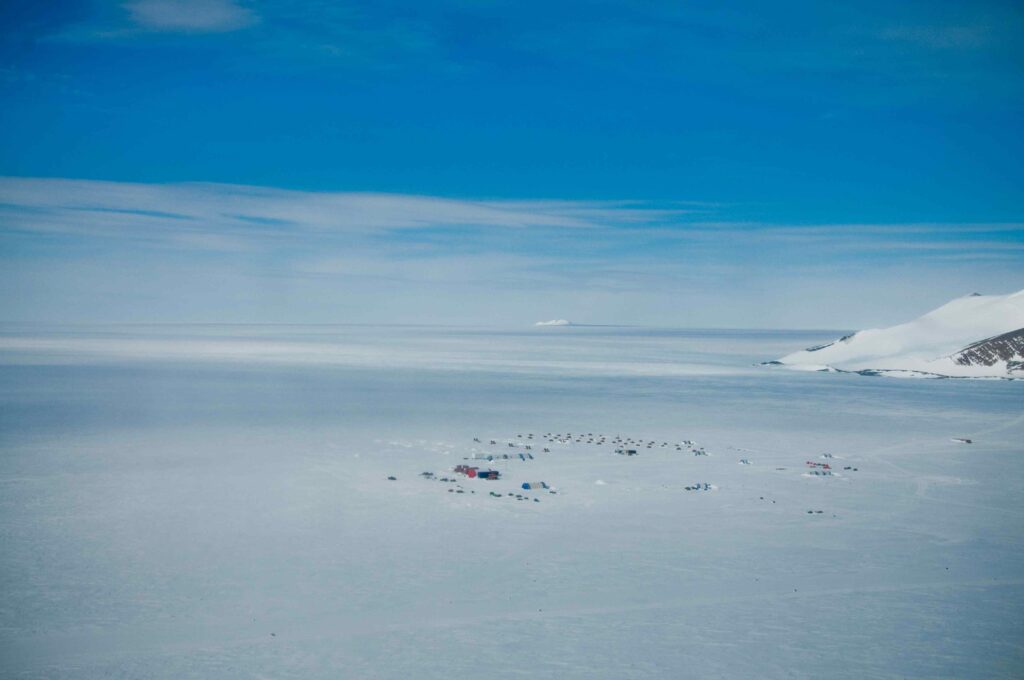
Patriot Hills camp from the hills above, truly in the middle of nowhere
The camp is serried rows of multi-coloured tents, large ones for the guests, small ones for the staff. In the middle there are big tents for the dining area and a hut with aerials for the communications. In the distance is the secondary snow runway with the twin otters parked on it, all fitted with skis. Beside that is the workshop full of snow-blowers, tractors and skidoos. One of the piste-bullies (those vehicles which groom the ski pistes in the alps) is inching its way between the tents removing all the snow accumulated during the last blizzard. Although it rarely snows in Antarctica the wind blows all the time, driving spin-drift snow along the ground. If there is any obstruction however small, a tent or even a pair of climbing boots a wall of snow builds up on the windward side and slowly buries it.

Blizzard in the camp
Five miles outside the camp there is the remains of an aircraft which got lost in a blizzard and came down just short of the runway. That was twenty years ago and now just the tip of the tail-plane pokes through the snow. The rest of this large aircraft is buried deep in the ice.
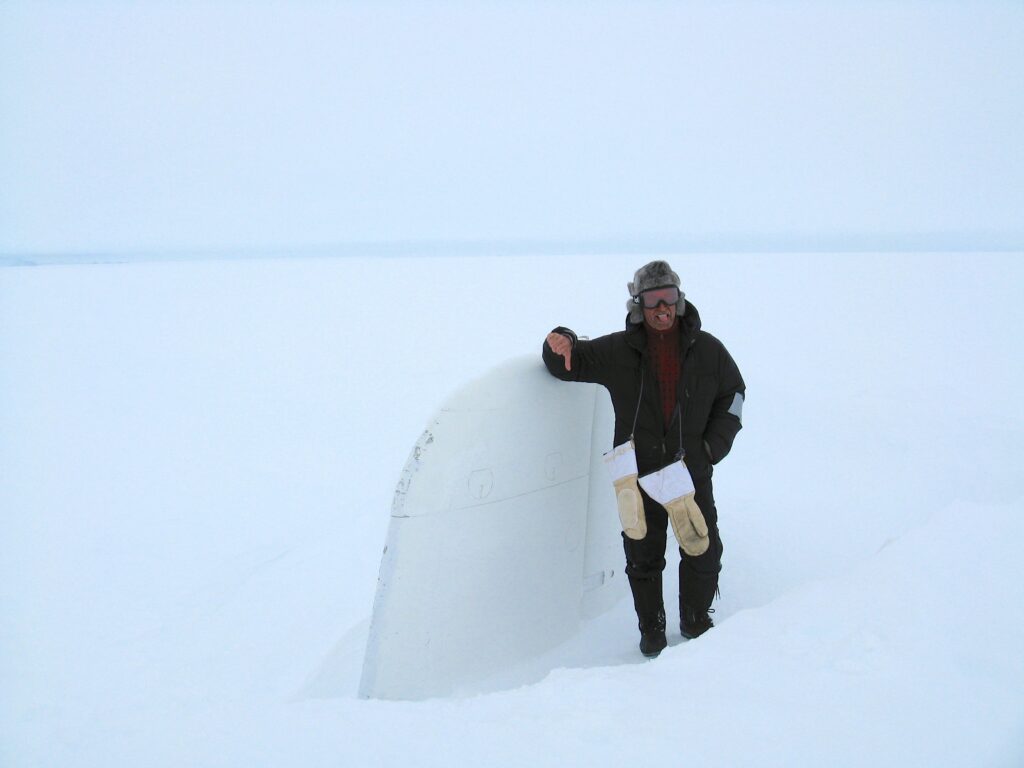
The tip of the tail of an aircraft that got it wrong a few years ago! The aircraft is now buried 30 feet deep in drifting snow
The mountains to the south of us are just the same. They present rocky cliffs to us, but over their shoulders ice is pouring like a shawl. It has built up behind these mountains and is now spilling thousands of feet down the sides. Looking north there is nothing.

The Ice wall looking South up to the plateau around the pole
The glacier is flat and pours slowly, ever so slowly to the edge of the sea some 100 miles away. Nothing blocks your view, no pylons, no radio masts, no chimneys, just a clean white line between snow and sky.
The medical tent is absolutely packed with kit. It has to be geared-up to deal with a major disaster, such as a fire or the Ilyushin crashing, through to an outbreak of food-poisoning. Then it has to cope with the whims of 100 wealthy guests who make the word ‘demanding’ take on a completely new meaning. You can spot the guests immediately. They have very dark glasses, and incredibly bright, very expensive jackets covered in badges. The staff are all in dungarees with no jackets as they are always working so hard it is too hot to wear anything else.
My fellow doctor is a very pleasant Swedish anaesthetist who has done a lot of mountain rescue courses. However, he looks a worried man and pretty quickly admits to me that he has got a girl pregnant back home and will be heading back from this trip to marry her. It transpires that she is a model who is reputed to have had an affair with David Beckham (she turns out to be Rebecca Loos). Sven is moving in exalted circles, certainly as far as the fashion magazines are concerned. However, he is well aware that this is his last trip away and he looks a little sad about that.
The medical tent has its own solar panel so we have plenty of electricity and as the sun shines day and night and there is never any cloud, a small panel and two batteries is enough for all our needs. Contact with the outside world is very difficult as the geo-stationary satellites are too low on the horizon, and even the oblique orbiting satellites only come over the horizon for a few minutes at a time. However we can buy expensive phone cards and they do work sometimes providing that there aren’t too many solar flares. I like to call Vicky every day – and have even from Afghanistan and Antarctica – and I discovered that I can do that even from here.
The operations room is a tiny box of an office with the metereologist packed in one corner with his computer screens. His input is crucial to everyone but most especially to the decision as to whether it is safe for the Ilyushin (IL76) to fly. The camp manager is working closely with Mark the meteorologist but he is also working with the pilots of the two twin otters which are used for ferrying clients around on the ice. A new plane has arrived this year, called a Baslar. It is an old DC3 (Dakota) fitted with new turbo-prop engines. The airframe dates back to the early 1950s and it is strange to see a plane still in action that used to ferry me from the Channel Islands to school when I was only eight years old.
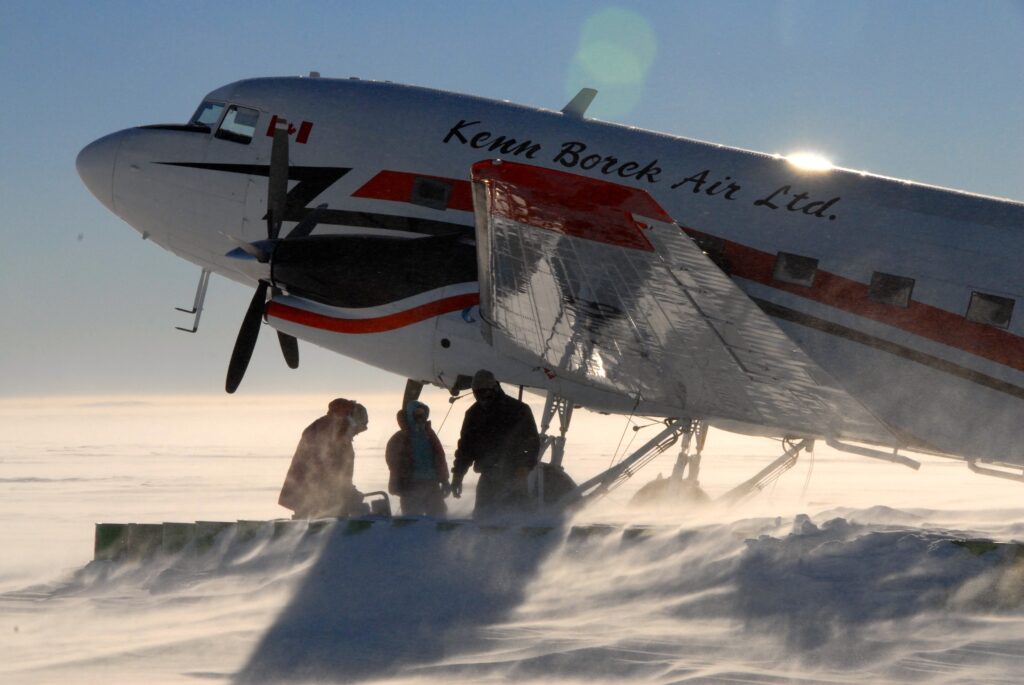
A Baslar refueling on its way to the South Pole
The radio operator is a real eccentric. He is a ham radio operator and is determined to lay out a huge aerial and try to contact his other hams in New York. He talks of little else, and this seems to be driving the base manager and the metereologist completely crazy. His job is to keep in contact with base in Punta Arenas and with the guides out in the field and to log all the calls.
So, what are all the clients doing? Well, some of them are doing the seven summits. They are climbing the highest mountain on every continent. In Antarctica this is Mt Vincent some sixty miles away from the Patriot Hills base. ALE have an advanced camp at the base of this mountain and the twin otters fly the clients to and from this camp. From there alpine guides lead them up the mountain. It is not an especially high mountain, nor is the climbing difficult. It is just very remote and when the weather does get bad, it gets simply horrible. The flight in to the mountain must be one of the most beautiful in the world. You fly along glaciers between unnamed and unclimbed mountains, and finally fly straight at the mountain where a glacier tips vertically over a cliff. Above the cliff the glacier is a steep snow slope and the plane literally climbs and stalls onto the landing strip. The advance camp is perched at the end and to one side of this very short strip. The wheels are chocked as soon as the plane stops to prevent it sliding back, then when it is ready to take off again, it pirouettes on one wheel rushes off down the slope and takes off only because the runway drops away beneath it as the glacier tumbles over the cliff. After a lot of begging and cajoling they let me fly out with one of the groups of climbers. The flight was marvelous, the landing breath-taking but the cream on the cake was a marvelous ‘ice-dog’ around the sun when we were there. Ice crystal in the air were creating the frozen equivalent of a rainbow, which comes out as a beautiful circle with four small suns arranged north, south, east, and west.

Ice dog on Mt Vinson
Just like the Himalayas there were any number of unclimbed challenging peaks in the Ellington Range but the clients just wanted to climb Mt Vinson because it was the highest. The rest of the range was empty and pristine.
There was always a bit of a panic when the clients left the main camp to do whatever they had come to Antarctica to do, climb Mt Vinson, visit the Emperor penguin colony, sledge to the pole or even fly to the pole. All of them had to fill in very comprehensive questionnaires on their health before they were allowed to come, but there was always one individual who would come to me just before they left and ask me about their Prinklewitz syndrome or some other condition which they had omitted to mention on their medical form but which was now filling them with foreboding. Luckily I had never heard of any of the conditions which they mentioned. I must have slept through those lectures, so I would simply slap them on the back and explain that ‘No-one ever leaves this world alive’ and then bundle them into the aircraft. Inside me a furious voice would be saying “Why, oh why, are you telling me this now?”. They all came back alive so I must have said and done the right thing.
Some hardy folk want to sledge from the sea(ice) at Hercules inlet to the South pole. That is a long slog and takes around 30 days. Others want to be able to say that they have sledged to the pole, but have not got the time. So they are taken to one degree (sixty miles) from the pole and sledge the last bit in. The eldest and most frail just want to be flown to the South Pole. One of the doctor’s jobs is to accompany these elderly clients, as the flight is a long one and the Pole is at an altitude of 10,000 feet, so we need to carry oxygen ready for anyone who gets into trouble. The Baslar that we use to fly to the pole is not heated nor is it pressurized. Although we had hot-water bottles tucked under our puffer jackets the cold was bone-chilling. Half way to the Pole the plane has to land to refuel from a depot of drums towed up there for that purpose. The clients have to be taken off one by one to have a pee while the pilots pump fuel as hard as they can to stay warm.
The South Pole is a dreary place. It was dreary when Scott arrived there to find Amundsen’s flag. It is a high flat windblown plateau but it is even worse now that the Americans have built a base right on it. Their first base is now almost buried by driving spindrift, but to avoid that happening a second time they have built a huge ugly Hilton hotel on stilts, slap on the South pole. In fact, the Pole is in their front yard. There was no need for them to build at the Pole, they could have put their base 10km away and left the site itself authentically bare, but I suspect this was a political gesture to the rest of the world who declined to contribute to the cost of building or running this huge base in the most remote part of the world.
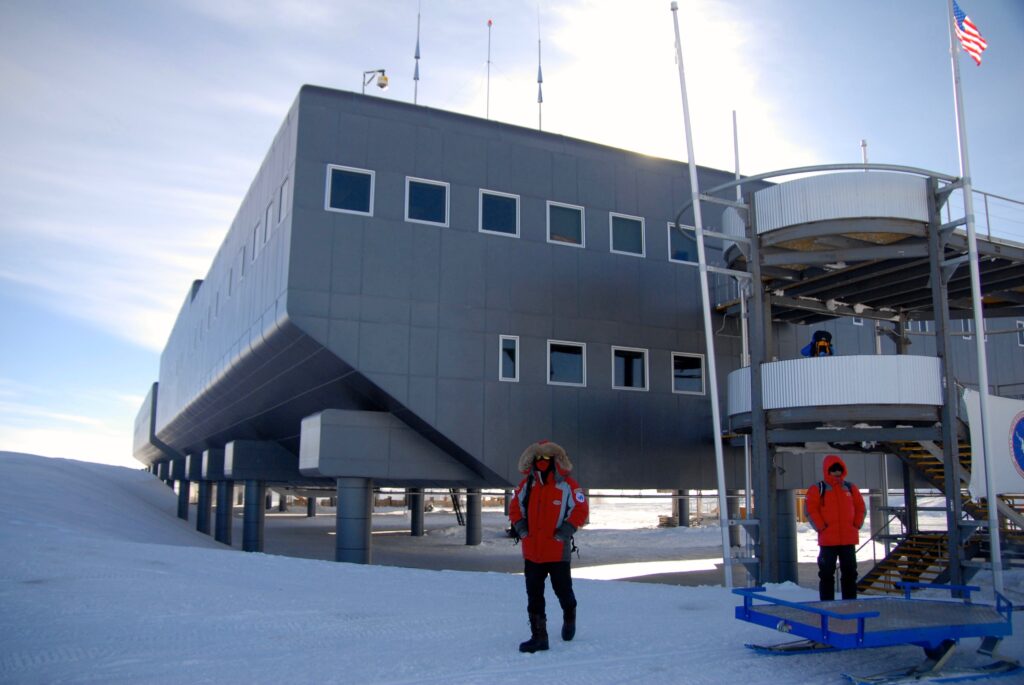
The American Base ON the South pole. It won’t win any architectural awards
The camp commander of the Pole base was the biggest woman I have ever seen. She must have been 6ft 4in tall and weighed around 200 lbs and she did not like visitors to her base. We were ushered in to the amazingly warm interior which was sterile clean and characterless. With great pride they showed us their hydroponics greenhouse where they were growing vegetables under artificial light. I dared not ask why they were doing this, when the sun was shining continuously outside. I dread to think what the electricity cost to generate to produce this light as all their diesel had to be dragged up in bowsers behind tractors all the way from McMurdo base on the coast.
To my amazement there were staff working in the base who had never been outside except when they transferred from the aircraft to the base and had no intention of doing so again until they went home. There was clearly an atmosphere and it was something to do with ALS bringing tourists to the Pole, but as I was new I could take no responsibility for that. Having done our tour of the base we went outside to take pictures of ourselves around the South Pole. Before we left I was ordered in the strictest terms not on any account to touch the American flag. I had no idea what the base commander was talking about, until I got to the South Pole, when I found that the USA had planted a flag pole right next to the brass dome which marks the exact position of the Pole. It is set so close that it is impossible to have a picture taken of yourself at the pole without being continuously slapped in the face by a very stiff Stars and stripes at -30 degrees. Now I understood the problem.
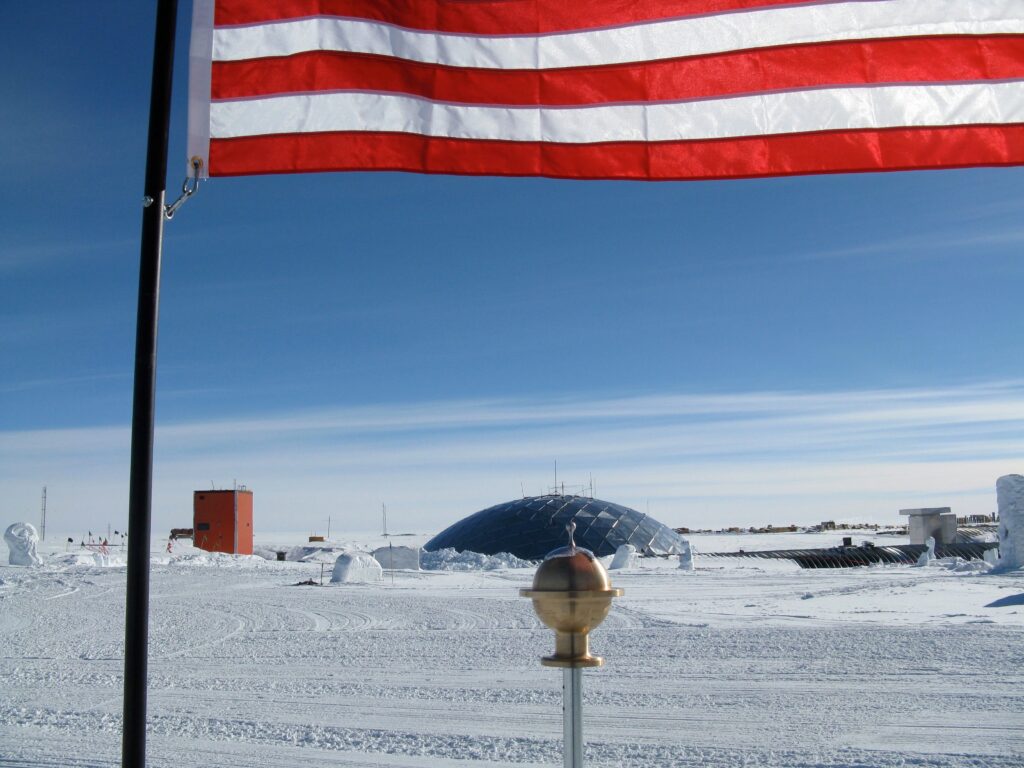
South Pole with old base in background and the American flag very much in the foreground.

They all seem to be fascinated in the fate of the first to jump into the water. Great white sharks are common here!
Their breeding burrows are high up and deep in the forest of the island. On the cliff there is a veritable Highway 77 leading to the forest with Penguins busily marching up and down it. We could sit at the base of this cliff watching them swim in and set off up the cliffs
Apparently it is rare to get such good weather at the Snares and certainly when we ventured round the south end of the Islands we suddenly found ourselves exposed to the full force of the wind and the waves

Surf breaking through a gap from the unprotected west side of the island. We decided to turn back
Again the zodiacs were hoisted aboard and the Orion set off south out of the roaring forties into the screaming fifties. Sure enough the wind picked up and we started to feel the real strength of the waves
Then we set off South again until we reached the Enderby Islands, the location of some simply terrible ship-wrecks in the late 19th century. The crews struggled to survive for years before the survivors were rescued. Now the islands are again un-inhabitated, but are the breeding ground for Sea Lions,

Massive sea lions guarding their Harems

Inland the Enderbys are coated in thick forest which at least provides shelter from the wind
As we went deeper South the wind rose and the we were now surging across the huge waves that roll all the way aound the world. Enderby is another set of islands which was trashed by sealers and by whalers. Within twelve years they had stripped out all the wildlife. So far, not much different from many other mountain tops in Zealandia. Then came a series of shipwrecks, each a desperate tale of misery as sailors struggled ashore only to die of cold and starvation. In a couple of cases there were enough survivors to tell the tale of what happens when man sinks to his lowest ebb. The postion of the islands was incorrectly recorded on the Admiralty charts and lay directly in the path of sailing ships heading up from Melbourne to Britain. So, they were a deadly trap in the fog and storms which are the normal weather for this part of the world. Now the Islands have shelters for shipwrecked sailors with finger posts pointing to the nearest shelter. They are also havens for wildlife and the populations of some are starting to recover. Today, the most dangerous thing going ashore is sea-lions breeding on the beech.

Sea-lions at Enderby waiting for us to land
The bull males with Harems were no problem. We just kept away from them. It was the young teenagers, stoked with testosterone who took our presence as a personal insult and mock charged us everywhere we turned.

The males with their harem and pups were just a delight to watch, snorting and roaring at each other as they marked out their domains.

The youngsters were football hooligans, stoked with testosterone and rushing out of the tussocks at us. A flag or stick held ‘en guarde’ temprarily stopped the charge, while we ushered the passengers through the danger zone.
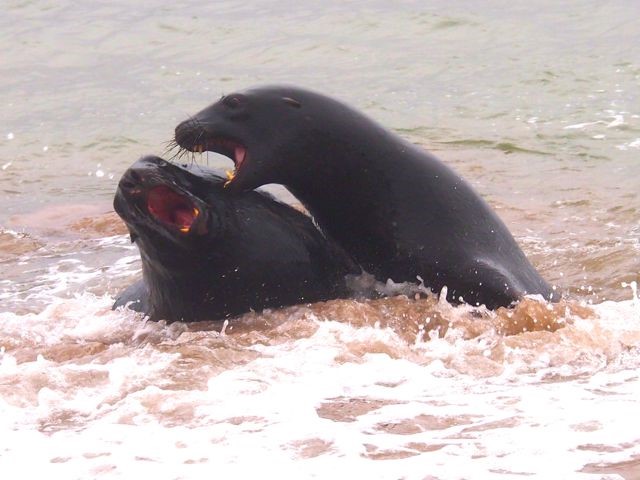
When they werent hassling us, they were beating each other up with tremendous roars and snorts.
Inland was the dense Rata forest which was impenetratble to the shipwrecked sailors and resulted in (at times) more than one group of ship-wrecked sailors living on the island unaware of the presence of the others.
On the tops there are meadows of sub-antarctic wild flowers dotted with Albatrosses nesting.
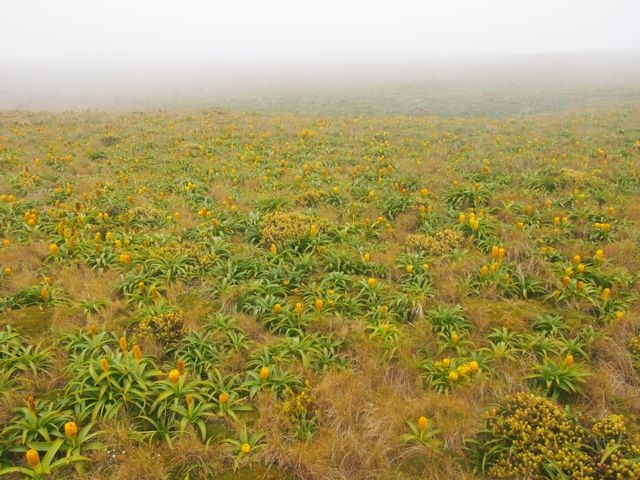
Meadows of Bulbinella

Bulbinella flowers

Carpets of gentians
On the far side of the island we came to the high cliffs which overhang the ocean and face the Westerly winds. It is here that the ships were dashed onto the rocks and the survivors scrambled ashore, then struggled to survive in the gales and driving rain and snow.
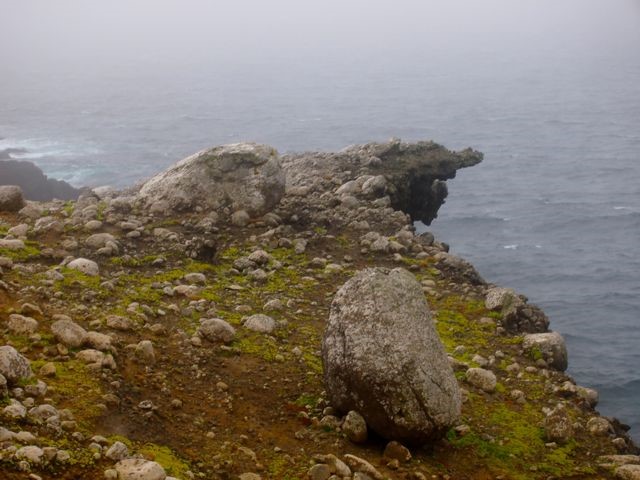
The brutal overhanging cliffs on the west side, hundreds of feet high and wreathed in fog, where so many ships were wrecked
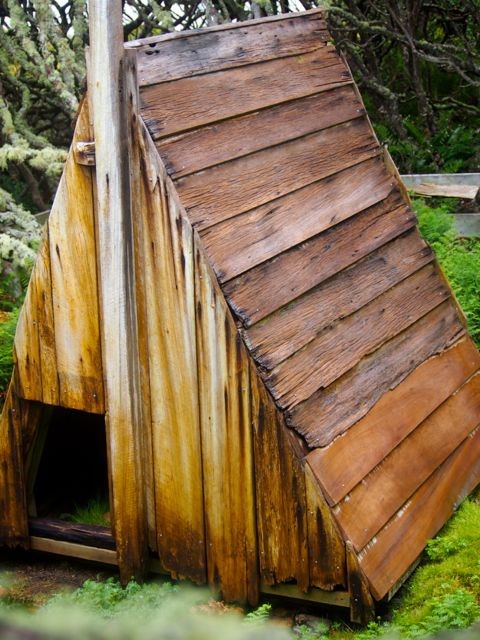
A survival hut built for ship-wrecked sailors. It is only 1.5 metres high
As we sailed away from Enderby wrapped in our thermal layers and Gortex jackets, I am sure all of us were wondering what it must have been like to be shipwrecked here for two years through winter and summer.
Campbell Island
South again to Campbell Island, a treeless island with beautiful mega-herbs dotted with Albatross nests. Its west coast are some of the most unforgiving cliffs that I have ever seen.
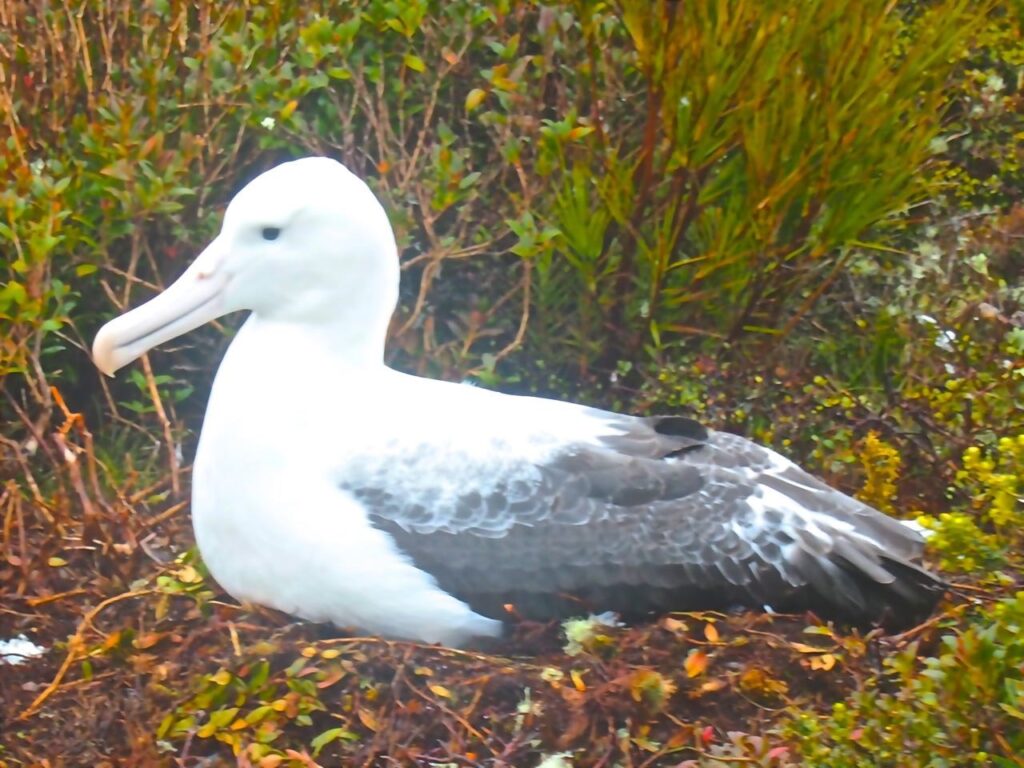
Albatrosses nesting amongst the strange megaherb vegetation
By the time we reached Campbell the wind was hurricane force. Extra weights had to be put into the zodiacs to stop them from being blown away in the gusts as we evacuated a guest with a broken leg. As we set off South again we were hit by a huge wave which stove in the rails in front of the bridge. The captain decided to turn back to take shelter in the lee of Campbell Island, but as we turned another wave hit the stern and stove in the railing there. That meant a lot of report writing for him.
The next bit of the journey south was spectacular with bigger seas than I have ever seen before. They were over 40 feet high but the length between each wave was so great that the ship managed most of them fine.
South from Campbell is Macquarie Island, which is equivalent to South Georgia in the quantity of wildlife.
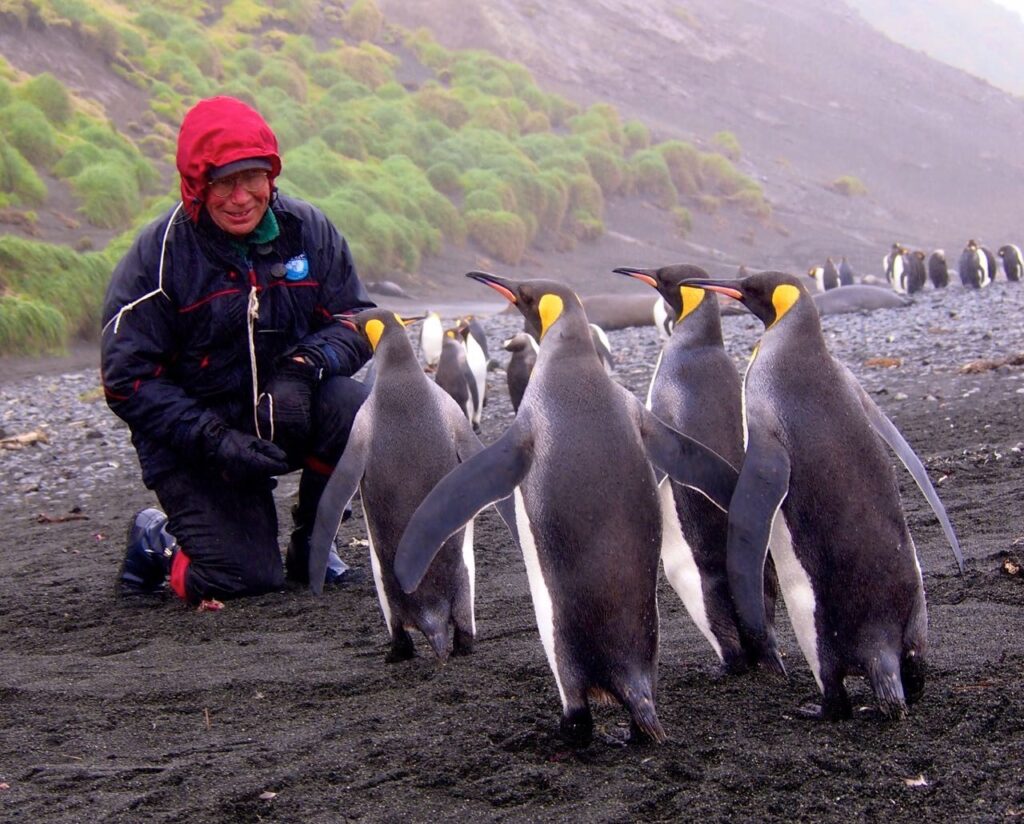
You may not approach wildlife but they can approach you!
It is the Southernmost tip of Zealandia although it is administered by Australia. In the last few years the Australian wildlife service have managed to eradicate all rabbits and rodents, but there are still 10 teams of hunters with dogs who roam the island making sure that there is not one survivor. This has been an very expensive project but should yield huge benefits to the Antarctic Wildlife
There is no natural anchorage at Macquarie nor is there an easy beach on which to land.
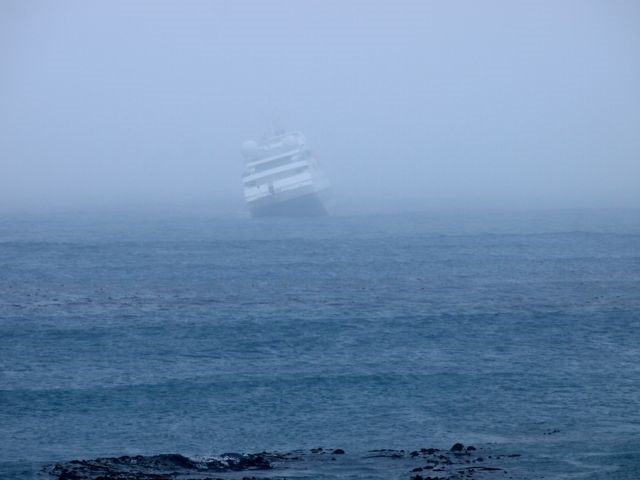
Orion rolling in the swell waiting to unload Zodiacs
Orion stands off shore and waits for the Zodiacs. When we first loaded in the morning, the fog was so thick that we could not see land and had to set off blind using our GPSs. The first crew ashore must do their best, but can then help the subsequent boats negotiate the surf. Today the swell was good to start with, dampened even further by the kelp lining the shore.

The landing crew wear chest high neoprene waders to catch and hold the Zodiacs as they land

The passengers hardly need get their feet wet

The problem is the wild-life which has no fear of us and is quite inquisitive
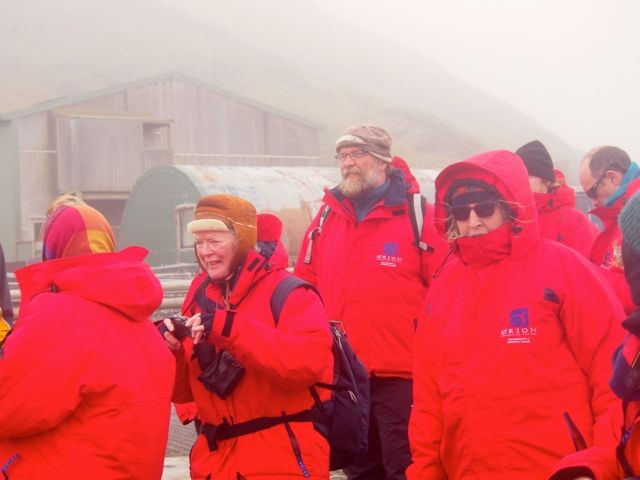
MacQuarie Island ain’t no tropical paradise but the wildlife is awesome, and the passengers loved it apart from the one who dropped a brand new and huge Canon telephoto lens into the sea while getting off a Zodiac to go ashore! Vicky is in the foreground on the right.
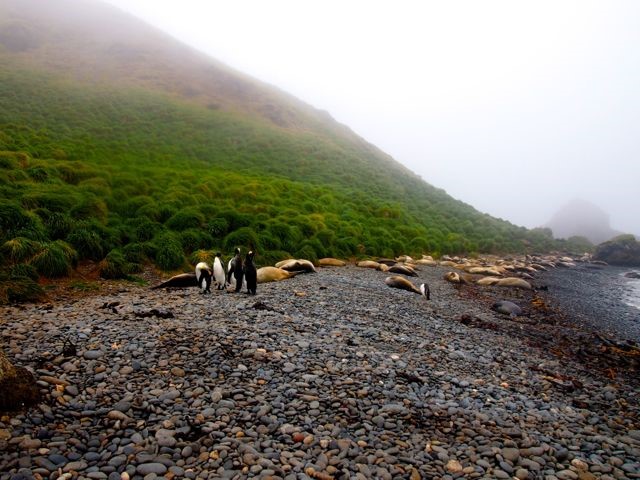
When you first land it looks good, but it gets better from there
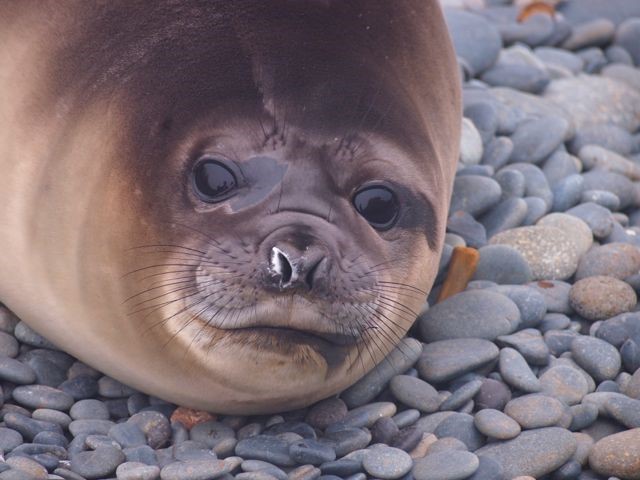
You are supposed to keep 10 metres distance from the wildlife, but if you sit still, baby sea-elephants crawl up to see you.
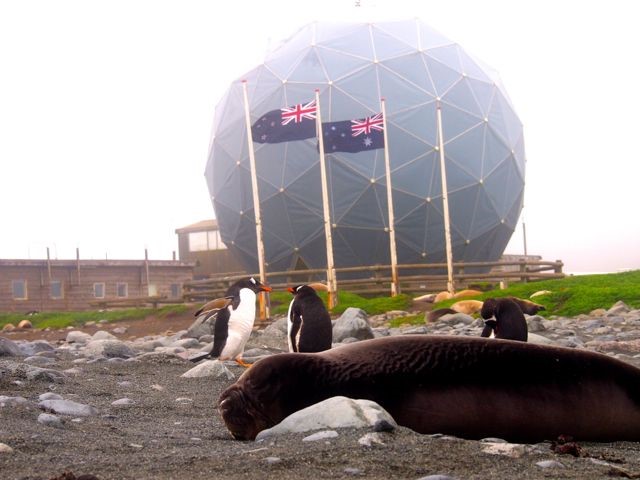
The Australians have a research station there but Wildlife clearly takes priority

All along the beach there is a constant roar of the male sea-elephants fighting

While young Gentoo penguins sit patiently waiting for their adult plumage

The colony of Royal Penguins is huge

The King Penguins on eggs look slightly uncomfortable

but not half as foolish as their chicks in their fur coats
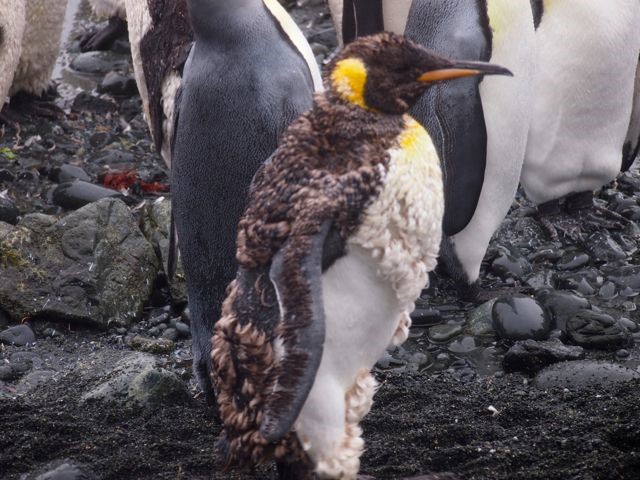
or as embarrassing as their teenage brothers moulting

and that is what I call a complete picture. King and Royal penguins, Vicky and sea-elephants

Royals heading out to sea

Sea-elephants frolicing in the river

The King Penguin colony is as big as that of the Royals. The chicks are at every level of maturity as the adults lay their eggs all the year round
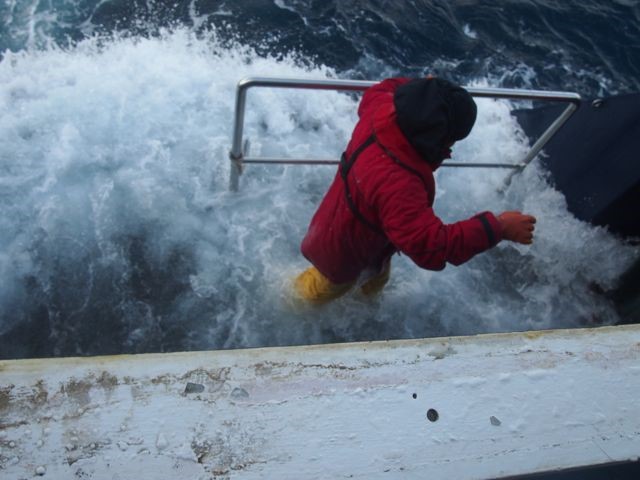
On our return the sea was up and the marina deck was becoming a liability

One passenger mistimed their step and had to be dragged aboard as the Zodiac sank away

Then a wave draining off the deck flooded the Zodiac. Luckily it did not have its passengers aboard
Our two day visit to Macquarie had been enhanced by the kindness and hospitality of the staff stationed on the base there. We brought them aboard for breakfast, lunch, hot showers and beer, but by the time it came for us to drop them back on their island the seas and the wind had risen. The parents of one of the young girls on the base were guests on the ship. As the conditions deteriorated their anxiety rose. One Zodiac swamped and I was now ready on deck with my medical kit. Finally, in a gap in the waves they embarked safely on the Zodiac. Then to our delight and their horror we saw a pod of Killer Whales appear beside the ship and follow their Zodiac into the shore. I have seldom seen such relieved looks on the faces of the girl’s parents when the Zodiac returned safely, all research team members safely landed. So, now back to New Zealand to pick up another group of passengers and then down to Antarctica proper.
Part of the reason why we were blocked by pack-ice is that there has been no westerly gale in the ‘furious fifties’ to drive the ice out to sea. On the slow two day journey back from the ice, the seas remained milky calm and the sun shone. North of us, gale after gale swept the sub-antarctic islands. During the journey, I used the opportunity to get some practice shooting the sun with the ship’s sextant, and finally got our positon to within five miles of the ‘correct’ one, which is continuously read off the GPS systems of which the ship has three! Of course THEY are all wrong! Now I have embarked on the even more arcane business of plotting our position by the stars. Not only are they difficult to identify, they are even more difficult to hold in the sextant’s mirror, and are absolute pigs to use for calculation from the Nautical Alamanac. So this will keep me busy for a bit.
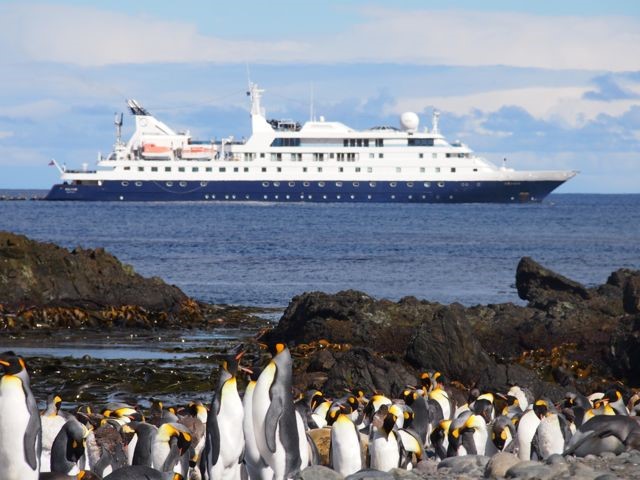
Orion anchored off shore.
When we arrived at Macquarie Island the southernmost of the sub-antarctic islands the sun decided to continue to shine, and the huge penguin colonies just glistened in the beautiful light.
Quite a contrast when on our last visit there had been normal Macquarie weather, gale force winds, fog and driving sleet.
The base welcomed us very kindly as before, and we tried to repay some of their hospitality with the offer of showers, meals, and beer. Their new doctor has arrived, a GP of my vintage. He showed me around their lovely hospital with dental chairs, operating tables, X-Rays and anaesthetic equipment. His equipment and drug store is a veritable Alladin’s cave. To cap it all he was a huge help over a difficult patient we had on board.
The weather was balmy and so to demonstrate the ‘true grit’ underlying the formation of the British Empire I was obliged to go ashore in shorts to the horror of the guests who had so much polar kit on, they could hardly move.

CB steps ahore in ‘Kiwi dinner dress’ (gumboots and shorts)

Don Macintyre the expedition team leader with Macquarie base in the background
The wild life were even tamer and inquisitive than before. We are not allowed to approach closer than 10 metres, but if they choose to approach us then that is fine!
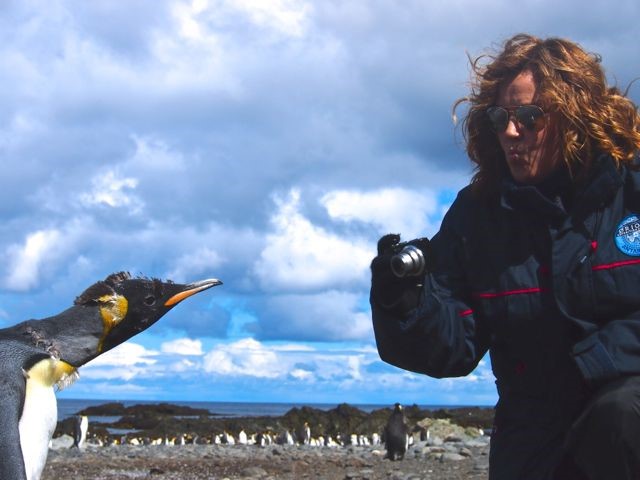
Fran the ships musician communes with a moulting King Penguin
King penguins of every age occupied one rookery standing aloof in their thousands while a quarter of a mile away even larger colonies of the smaller Royal penguins showed off their glorious crests.
The wonderful light and the tameness of the wildlife made close-up pictures too easy.
Then we headed North again to Campbell Island, notorious for only 16 days of sun a year. When we were last there, two weeks before, the ship’s anemometer recorded 54 knots in the shelter of the land. This time all was still, and we were able to walk up and over to the notorious west coast of the island where so many ships have been wrecked.
King penguins of every age occupied one rookery standing aloof in their thousands while a quarter of a mile away even larger colonies of the smaller Royal penguins showed off their glorious crests.

Two King penguins courting
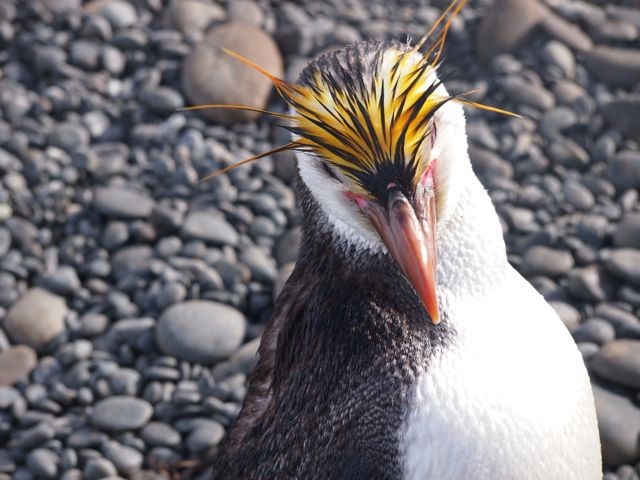
A Royal shows off his crest

One of the Royal Penguin rookeries
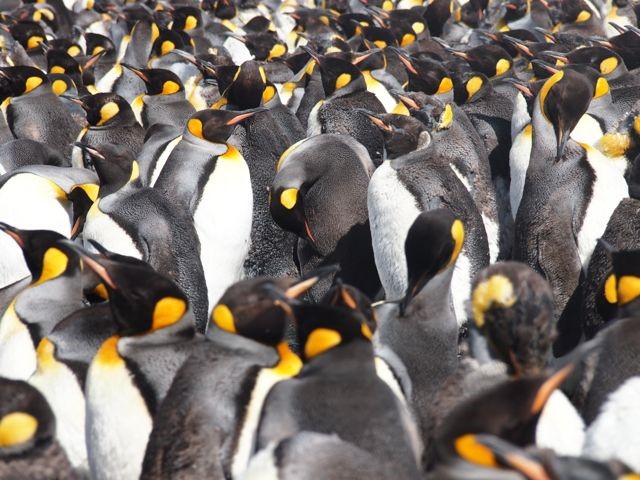
Looking into the King Penguin colony
The wonderful light and the tameness of the wildlife made close-up pictures almost easy.

A sea-elephant offers himself up for dental inspection

A Royal Penguins poses for a profile view

Such handsome birds
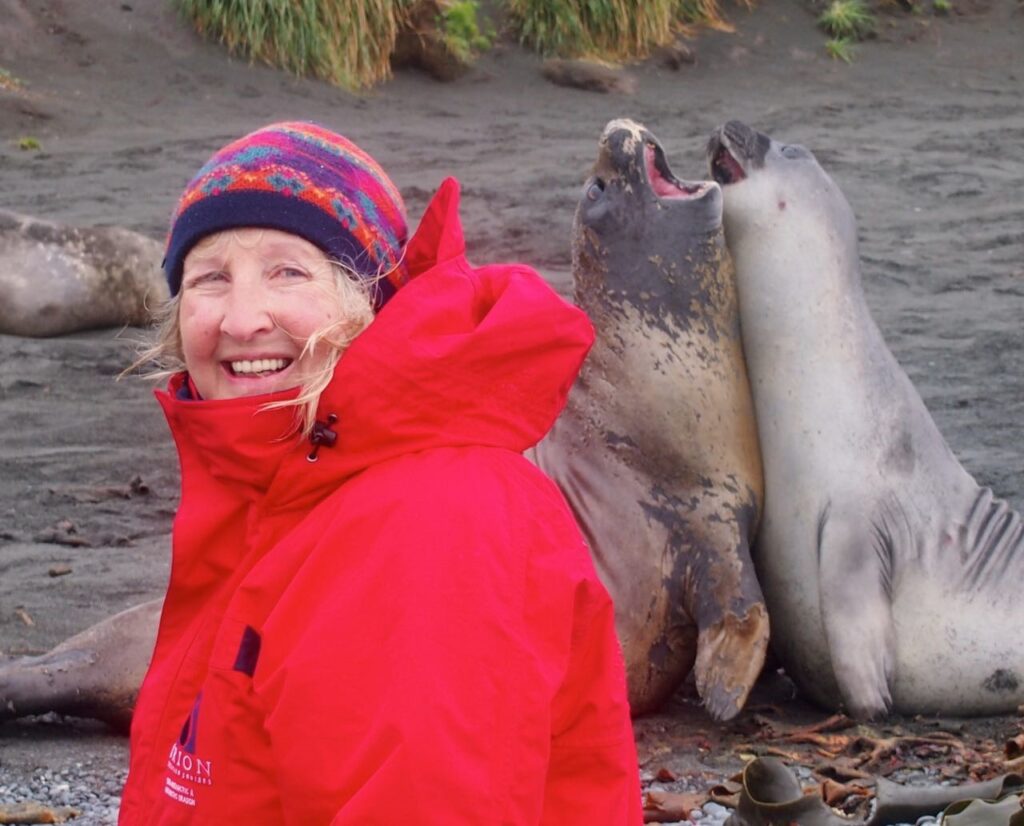
Vicky being fought over by males
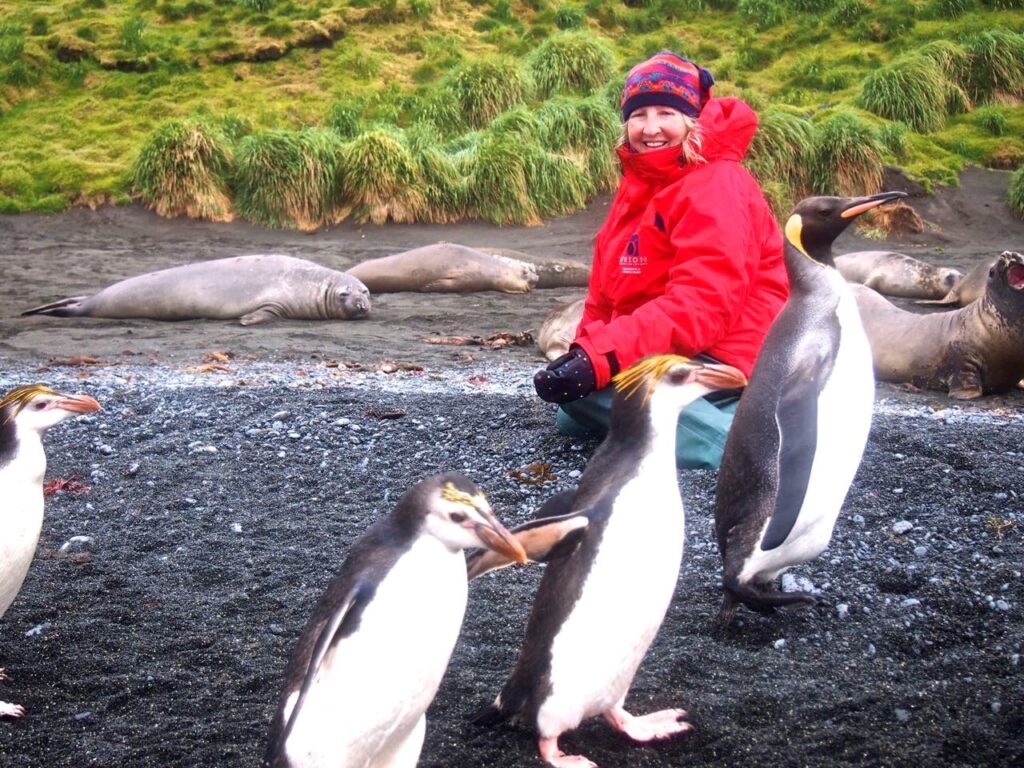
and watching the world go by
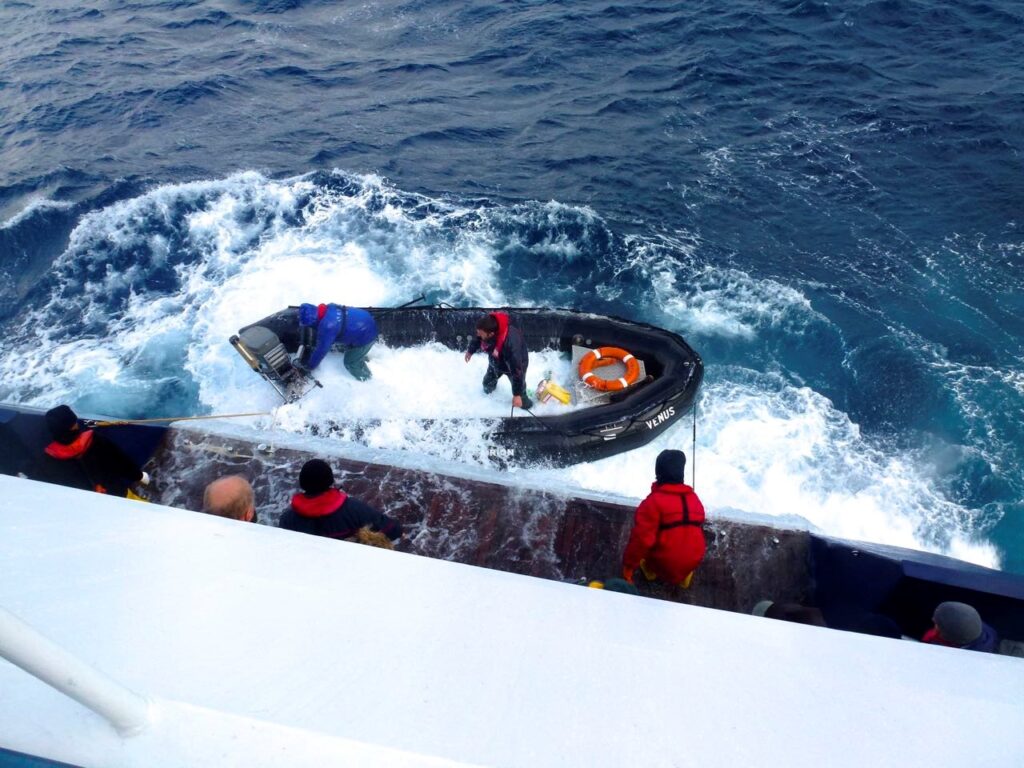
The seas were rough and the Zodiacs could get swamped while trying to load
Then we headed North again to Campbell Island, notorious for only 16 days of sun a year. When we were last there, two weeks before, the ship’s anemometer recorded 54 knots in the shelter of the land. This time all was still, and we were able to walk up and over to the notorious west coast of the island where so many ships have been wrecked.
The final part of the trip was into the Ross sea to visit Shackleton’s and Scott’s Huts on the ice shelf.
We are now heading down to the coast of Antarctica. Last night the ship’s engines slowed, and because my cabin is next to the engine room I woke at once. I peered out of my porthole and in the gloaming (now it doesn’t get dark at all) an iceberg sailed serenely past and vanished into the fog. Apparently we had to slow down because there may be ‘growlers’ around it (fragments which have broken off and which are mainly submerged).